Wednesday, November 30, 2011

Sweetbread Bailey: Presidents and Pastries (In it for the dough)...

...which is also the title of my new band's debut release. It's a mix of early New Wave dance beats with underpinnings of pop art and minimalism. Our biggest influences are Jean-Paul Sartre, ironic mustaches and money from our suburban dads. And we all dress like it's 1983, which is actually 8 years before we were born. Our live performances are eye-opening, but the bourgeoise types wouldn't get it. We haven't had our record reviewed by Pitchfork yet, but we're confident it will score at least a 7.6.

Wait, what?

This is a baseball blog. Ostensibly, anyway. Sometimes I write a little bit and then discover that it's clever and I digress. Imagine that: A self-indulgent blog1. But we'll save that discussion for a later, much more self-referential post.

Today's GNIB post covers the life and times of Abraham Lincoln Bailey, a native of the, well, Land of Lincoln. That's hardly surprising, I guess; Illinois has an infatuation for the 16th commander in chief. The name puts in him some good company with other players named after presidents.

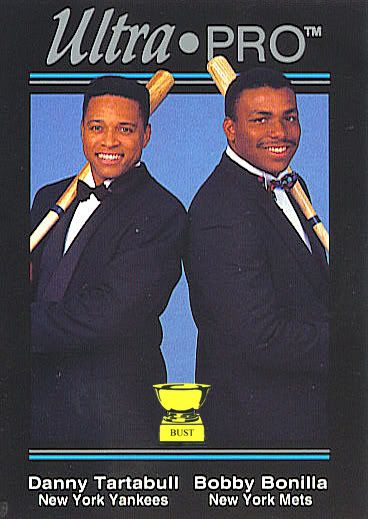
But Abe Bailey actually played under the auspices of Sweetbread Bailey, a name which adds him to the All-Time Pastry Team: Cookie Lavagetto, Pie Traynor, Jim "Cakes" Palmer, Doughnut Bill Carrick, Danny Tartabull, minor leaguer Christopher Danish, minor leaguer Russell Loafman and Baklava Van Troy.

As a young phenom in Joliet, Sweetbread passed up an opportunity to pitch for the Chicago Cubs in 1917, instead serving in World War I with the 72nd Field Artillery in the army2. Upon returning, however, the Cubs signed him to pitch for the club. Bailey pitched in relief for the Chicago Cubs from 1919 to 1921, when he was traded to the Brooklyn Robins. His career was over after the 1921 season.

Sadly, Bailey died in 1939 at the young age of 44 in the same town in which he was born. Naturally, coffee and sweet rolls were served after the burial.


1 If your blog isn't sufficiently self-involved, then you're doing it wrong.

2 Bailey is alleged to have invented the bread helmet during the Great War, a device that would not gain popularity for nearly another 100 years.

Thursday, November 17, 2011

Amos Rusie: The Hoosier Thunderbolt


Honors for the Hoosier Thunderbolt1 in three hastily-hewn haiku2:


Tavern

One Thunderbolt please.
Don't skimp on the gin, either.
Two dimes for the 'keep3.


Inning

The Amos Rusie--
Flail at one, two, three fastballs.
Repeat and again.


Regimen

Spring training's arrived.
How 'bout a drink or seven?
He's as good as e'er.


Read about Amos Rusie's drinking baseball exploits here.


1 This sounds like a much better name for a train line than the Hoosier State. Mitch Daniels, forget all that government crap and legislative process and so forth. Make this a priority.

2 The plural of haiku is haiku. Also, this hack writer is terrible at creating them.

3 Rusie's grand moniker led to a drink of the same name. While research does not turn up any information on a recipe, it's probably safe to assume it had gin in it.

Wednesday, November 16, 2011

Studs Bancker: Investing in pain


John V. "Studs" Bancker played during the year when New Haven had a professional baseball team and that professional baseball team was called the Elm Citys.

Studs fancied himself a catcher and an infielder, though he was a not regular starter on the 1875 club and in fact was a poor hitter.

After his sole season in professional ball, Bancker worked successfully in private securities. And by this, I mean that he wielded a cudgel, which he used to break debtors' extremities.

It's rumored that 11-year-old Philadelphian Ossee Schrecengost once watched Studs go 3-for-3 on a trio of downcast gamblers. Young Ossee remembered that day and frequently described it in wistful tones after a few servings of pitcher's juice.

Studs Bancker died of dysentery in 1888 at 35, having collected a record-high 3,762 kneecap hits.

Friday, November 11, 2011

Lou Skizas: Slugger, time traveler, sound investor


Lou Skizas ostensibly earned his nickname "The Nervous Greek" from a lengthy routine he performed before each at-bat. The Chicagoan outfielder's ritual makes Nomar Garciaparra's pre-batting routine look like Warren Newson's, if you know what I mean.

However, in a rare and completely fabricated interview, Skizas disclosed that he actually picked up the nickname after constantly mumbling to his 1950s teammates about the financial crisis striking his homeland1...in 2010.

Teammates dismissed his ramblings as incoherent babbling and a nervous tic. But Skizas HAD traveled to the future, thanks to a clever device obtained from the back of a cheesy science fiction paperback. While in the future, Lou visited with his still-alive self in 20112 and returned to the 1950s to tell of the great embarrassments suffered by the Greek people in the 21st Century.

After many years of arguing about the future, Lou realized no one would ever believe him, so he settled in to everyday, post-baseball life. He earned a PhD in biology and taught at Illinois State University and the University of Illinois, where he also coached the baseball team.

He's since retired from teaching, though he at times worked a scout for the Chicago Cubs. Today, Skizas lives near Chicago somewhere, sitting on top of a pile of money he's made on sports betting, thanks to a sports almanac he's kept under his pillow for 55 years.

Read Lou Skizas' actual story here.


1 Actually, Skizas' homeland was Chicago, though his parents had immigrated from Greece.

2 The astute reader will mention paradoxes here. The author wonders why this interrupts your suspension of disbelief, but you can believe the plot of any episode of Doctor Who. Sure, it's fine when writers pull magical sci-fi crap to whitewash poor plot planning, but when someone tries to create a fictional account of a real person's life, it becomes unacceptable. Well screw you! We don't need you anyway2A!

2A Please don't stop reading. Although if you do stop reading, our sponsor will send hooligans to your front door with bar mallets in hand.

Thursday, November 10, 2011

Elton Chamberlain: Cool as Ice*

Elton "Ice Box" Chamberlain may have been the original mold for the late nineteenth century baseballist. A sturdy and reliable pitcher for 10 years, Ice Box picked up his nickname from hyperbolic scribes' descriptions of his coolness in the pitcher's box1. In 10 seasons, he won 157 games and was an above-average pitcher in an era where offense ruled the game. He even pitched with his left hand on occasion, an accomplishment also undertaken by one of Chamberlain's contemporaries: lady killer and GNIB honoree Tony Mullane.

In addition to his pitching credibility, Ice Box engaged in all of the traditional, unsavory baseballist off-field engagements of the times.

He bet heavily on boxing. Of course, this is not in itself a crime. But Chamberlain netted himself a hefty $50 (!) fine for helping fix a match in 1891. In another match, Ice Box won a diamond ring from a bet on brawler Edward Gorman. Like any good bettor, Chamberlain lent Gorman the ring. After it became apparent that the ring was never coming back, Ice Box had Gorman arrested and jailed for grand larceny2.

Of course, the natural post-career appointment for a man of such repute is self-evident: Ice Box was hired to be a National League umpire in the 1896 offseason. While the reason is unclear, the result is not. Chamberlain was fired before long.

Not only was Chamberlain a fisticuffs fan, he fancied the occasional participation in what can only be dubbed "assault and battery for fun and profit."

In one instance, Cincinnati teammate and outfielder Jocko Halligan ravaged a bar during what baseball historians have determined "an ordinary baseballist's Thursday." After battering one teammate into a pulp, Halligan3 spotted Chamberlain at the bar and decided that a doubleheader was in order. Ice Box, however, was watching Halligan's approach in the bar mirror. As Jocko lunged, Ice Box turned with a bar mallet4 in hand and coolly dispatched of the raging outfielder.

Ice Box's post-baseball life is not at all documented, outside of his death in 1929. Some say that he worked in a consulting role with baseball hatchet-man extraordinaire Ossee Schrecengost and that he once began a brawl in Cleveland that ended 390 miles away.

All we know is...he's called a prick.

Read the SABR Project bio of Ice Box Chamberlain here.


* For information on this article post's title, rent Cool as Ice (1991), starring award-winning human being Vanilla Ice. Also, please take a moment to enjoy Ice Box Chamberlain's baseball card, presented by Old Judge Cigarettes. Remember kids, Old Judge Cigarettes wrote THE verdict in smoothness.

1 A thorough researching has indicated that rejected nicknames included: Iceberg Spleen, Glacial Glands, Winter Worm, Nattering Nabob of Numbness, Chisel Cheeks and The Rimy Buffalo Hurler.

2 Ed Gorman once defeated a Kiwi world champion named Torpedo Billy Murphy in 1891 in Rock Springs, Wyoming. He also allegedly won a 53-round bout with Billy Hawkins in Chicago by forfeit, though at least one press outfit claimed the fight was a canard. This author finds the claim confusing and dubious, for airplanes had yet to fly, let alone planes with complex aerodynamic surfaces.

3 Jocko was a common enough nickname in baseball. For more information on Halligan's story, please see his succinct entry in the SABR encyclopedia.

4 Can anyone tell me what a bar mallet is, by the way? All of my research indicates that it was either a golf club or a piece of percussion equipment. Because I don't want to venture off on a tangent of a tangent about why he was carrying a golf club or percussion equipment4A, I'll just assume that a bar mallet is a
10-lb. hammer (because Nine-Pound Hammers are for hillbillies), which Ice Box carried with him because Ohio state laws permit concealed carrying of large, blunt objects for just such occasions.

4A Actually, that's never stopped this author from supposition. However, in this instance, I can find no other reason why a roughshod baseballist would carry such items other than to flog his opponents in battle. Chamberlain certainly was not a purveyor of gentlemanly pursuits like golf, nor was he inclined to song, save the dull, rhythmic thudding of a melee.

Monday, October 31, 2011

Doug Gwosdz: If you see multiple vowels, your eyes are broken


For much of the country, Polish last names present linguistic challenges unparalleled in the languages of Europe. However, having grown up near Chicago, I'm familiar with many of the rules of Polish pronunciation and can usually work a new name out in a few seconds. In fact, I pride myself on correctly pronouncing the name of St. Louis Cardinals' reliever Mark Rzepczynski correctly when I first saw it.

But I am not perfect. When I saw Doug Gwosdz1's name crop up while doing some incredibly detailed research for GNIB, I pronounced it "Gwosh." Which is wrong.

Gwosdz's last name has been discussed at length here, but the short version is that it's pronounced "Goosh" and he quickly drew the nickname "Eyechart" from former major league backstop Chris Cannizzaro.

Gwosdz, a catcher, played just 69 games for the San Diego Padres from 1981 to 1984. His offensive numbers are unimpressive, though he was a good defender. In all honesty, his odd name is probably his most notable achievement in the long annals of baseball history. But at least he doesn't dwell in total baseball anonymity.

Read an incredibly short interview with Gwosdz here. Read this while if you're surfing the 'net, also.Link

1 I can say with relative certainty that the Calgary Cannons got a huge lot of Chicago Cubs hats that were surplus souvenirs from the Cubs' dark years. This would be explainable if the Cannons were affiliated with the Cubs, but they were instead the AAA team of the Seattle Mariners.

Friday, October 28, 2011

Bris Lord: All your pork are belong to us


Philadelphia Athletics outfielder Bristol 'Bris' Lord played on Connie Mack's legendary teams of the early 20th Century.

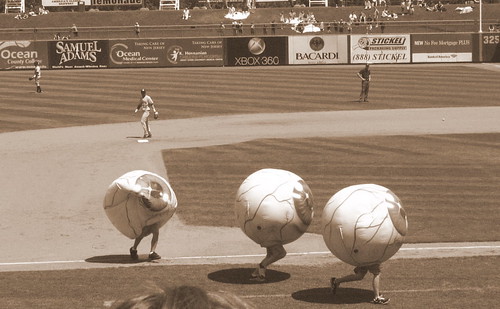
An average career hitter, Bris at some point picked up the nickname "The Human Eyeball." This nickname is a bit mysterious as his walk rates aren't terribly impressive and he struck out quite a bit for the Deadball Era, calling his eyesight and strike zone judgment into question. Maybe it came from his ability to spot a fetching prostitute from three city blocks away. Or perhaps it, uh...

...hmmm...that's an odd...wait...is that?

HOLY SHIT1! This man's middle name is Robot Ham! And his last name is Lord! He was the Robot Ham Lord!

What could possibly drive parents to christen their child with such an incredibly conceptual name? Is Athletics teammate Ossee Schrecengost responsible? Was it time-traveling, sentient porcine bipeds incubating swine flu? Was it related in any way to the assassination of James A. Garfield two years before the Robot Ham Lord's birth2? Who succeeded Bristol as the next Robot Ham Lord3? And why was his nickname synonymous with the Jewish circumcision ritual4?

All of these questions will be answered in my forthcoming speculative historical conspiracy theory book "Eye in the Sty: Rulers of the Underground Autonomous Mechanical Pig Society in America, 1860-19945."


1 Pardon the profanity, but a more splendid name has never reached this hack writer's eyes.

2 It is not unreasonable to think that Charles J. Guiteau, himself of French (!) descent, acted in the interests of God, who had clearly told him to kill the president. Some people say, however, that this was a misinterpretation of Guiteau's confession, in which he claimed that he had acted on orders from the "Robot Ham Lord." Of course, as the word "robot" was not yet introduced (Guiteau's words are evidence for the time-traveling porcine biped theory), it was all dismissed as gibberish except for the bit about the "Lord."

3 And what was the method for determining succession? Was it birthright? In my soon-to-be-published book, I will give details on how the Athletics' acquisition of Bris Lord from the Cleveland Indians in 1911 was actually the method for secretly passing the title to Shoeless Joe Jackson, who would attempt to infect America's game in 1919 during the Black Sox Scandal. Historical accounts consider Jackson a dimwit, but few know that he actually masterminded the whole scandal.

4 Some astute scholars have also claimed that the Robot Hams were sent back to the 1860s by pork farmers from the future (part pig themselves by this time) in order to spread the use of futuristic and kosher bacon. Unfortunately, the pigborgs sent back in time almost immediately failed to spread the neo-bacon gospel and instead got distracted by the Machiavellian workings of inner-city politics and the vices that come with it.

5 No psychotropic drugs were harmed in the making of this post. This post has been brought to you by Extreme Boredom: Now in Audio Form!

Thursday, October 27, 2011

Jim Dyck: There's no 'I' in Dyck, but there are players a lot like him

[Author's note: I will do my best to refrain from making weiner jokes. Those have been made here plenty in the past. Feel free to make your own, though.]

Jim Dyck's story is a familiar one, not only with respect to baseball, but also to men of nearly all nations who came of age in the middle third of the 20th Century: A raging inferno of international lunacy drew men from all countries and interrupted their goals and ambitions. Those who escaped with their lives returned home and did their best to find normality.

But what makes Dyck's story so familiar is that it is nearly identical to a previous GNIB entry, Hank 'Bow Wow' Arft. Observe:

- Arft (1/28/22) and Dyck (2/3/22) were born six days apart.
- Both players had been promising young players from the middle of the country (Arft was from suburban St. Louis; Dyck came from Omaha).
- Both served served in the Navy during World War II (Arft served on a destroyer escort; Dyck was a naval pilot).
- And both debuted in their late twenties with the St. Louis Browns (Arft in 1948 at 26, Dyck in 1951 at 29).

In fact, there is very little that separates them statistically. Look at their career numbers:

Arft: .253/.352/.375, 300 G, 1056 PA, 13 HR, 114 RBI, 137 BB, 133 K
Dyck: .246/.339/.389, 330 G, 1134 PA, 26 HR, 116 RBI, 131 BB, 140K

While it's true that neither player's numbers are truly remarkable, the only discernible statistical difference is that Dyck hit a few more home runs and walked a little less (but not significantly so).

The two men's careers barely overlapped, though. Arft was relegated to the bench during Dyck's first couple seasons and was released when Dyck was one of the most important members of the '52 Browns squad. As the Browns' starting third baseman, he was second on the team that year in home runs and RBI.

Dyck was largely washed-up after 1953, though he played a few games with the Cleveland Indians in 1954 before finding his way to the St. Louis Browns' new digs in Baltimore with the 1955 Orioles club. He was out of the big leagues by 1956 and had retired from minor-league ball in 1961 after putting up respectable numbers.

In another parallel with Hank Arft, Dyck went into business for himself after retiring. However, Dyck founded his own bowling alley instead of opening a mortuary as Arft had. Naturally, the two men died only three years apart, with Dyck succumbing to cancer in 1999.

Ned Garvin: Tough-luck ancestor of a fictional character


Today's entry is not particularly notable for having a "great name." Rather, he is best remembered for having a name that is just a couple letters away from one of Dan Akroyd's best, albeit more obscure1, Saturday Night Live characters. Watch the skit here. I'll wait; it's only 7:16 long.

So let's discuss Fred Garvin's great-great grandfather, Virgil Lee "Ned" Garvin. Ned pitched at the turn of the century and is perhaps best known as being the best pitcher on several bad teams. Naturally, the photo above seems to display him making the "OKAY" face at his manager, who insisted on pushing him out to the pitching mound in front a team of staggering ineptitude.

In his career, Garvin earned only 58 wins against 97 losses, but in that time he accrued an earned run average (ERA) 25% better than the league average. His career 3.9 strikeouts per 9 innings is low by today's standards, but it represents an excellent mark for his era. Of his few career victories, Ned had to earn 13 of them by shutting out the opposition and waiting for his terrible teammates to trot a run across the plate.

Ned's 1904 season with the Brooklyn Superbas was a perfect reflection of his career. He put together a putrid 5-15 win-loss record but had a sexy 1.68 ERA, which was second-best in the National League. The culprit for his terrible record was obvious: Unbelievably bad defense behind him and a lineup that was wretched, even for the Deadball Era.

While major-league defense was generally bad in the early years of baseball (fielding gloves were small and harder to flex), fewer than half the runs scored on Garvin in 1904 were earned. And his dynamite performances were also halted by an awful team batting performance of .232/.297/.2952.

The New York Highlanders claimed him toward the end of 1904, and Garvin made his last two big-league starts in the Bronx. Naturally, he didn't win either of them.

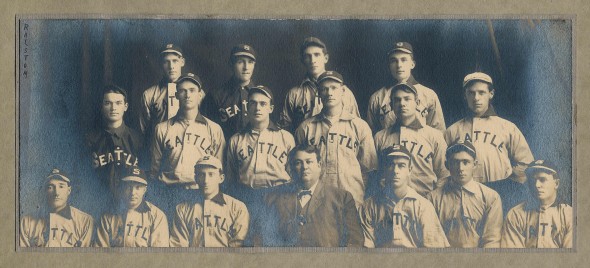
Following the 1904 season, Ned Garvin packed up and headed out West to play, dominating the Pacific Coast League with the Portland Beavers and Seattle Siwashes3 in 1905 and 1906. Garvin's luck never got much better; he played his final season in 1907 with the unfortunately named Butte Miners4 of the Northwestern League, though he again dominated.

Sadly, Ned's tale ends in 1908, when he died of consumption...by bears5.


1 You've probably never seen it; it's really underground. I mean it was on a major network and all, but you probably would like something like the Mel's Hide Heaven skit better.

2 The 1904 Brooklyn Superbas featured three starters who hit batted under .200. In fact, the only bright spot in the wholeoffense was Harry Lumley, who was basically Garvin's position-player counterpart. Lumley led the National League in home runs (9) and triples (18) in 1904, though he also led both leagues in strikeouts (105), too. Garvin, however, escaped Brooklyn, while Lumley was destined to play until 1910 with Dem Bums.

3 A Siwash, by the way, is a disparaging term for an American Indian in the Pacific Northwest. Take that, early 20th Century Cleveland fans! What's that? Cleveland today has a somehow more offensive mascot?

4 Actual team name. Google with care.

5 Not actually true. But Ned Garvin die of consumption the disease.

Tuesday, October 25, 2011

1912 Pittsburgh Pirates: Flavors of cups of coffees of excessive prepositional phrasing


The Pittsburgh Pirates of the early 20th Century were one of the best National League clubs of the era. From 1900-1912, the team never finished lower than fourth in the league. They won 90 games nine times in that span, took four pennants and won the World Series in 19091, a season in which they'd compiled a staggering 110-42 record. The Pirates of the era were led by superstar shortstop Honus Wagner, outfielder/third baseman Tommy Leach and ace Deacon Phillippe2, among others.

1912 found the Pirates employing several players of outstanding moniker for a cup of coffee or two. Rather than give each player (many of whom only played a handful of games) his own post, let's explore them in brief and revel in their fantastic names.


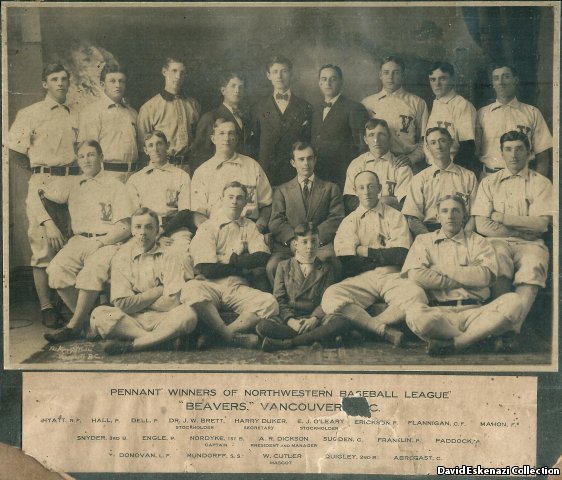
Ham Hyatt (1B/OF) - Robert Hamilton Hyatt would play more than any other player on this list, sticking around for much of the 1910s. Ham was a slugger in the minor leagues before and after his time in the majors, hitting 15 home runs for the Vancouver Beavers of the Northwestern League in 1908. In parts of five seasons with the Pirates (1909-1910, 1912-1914), Ham hit six home runs and batted .277. He'd get a chance to start more with the St. Louis Cardinals in 1915, but he was out of big-league ball until getting some pinch-hit opportunities with the New York Yankees in 1918. He played his final three seasons with the Vernon Tigers of the Pacific Coast League, crushing 39 home runs and batting well over .300.

Name rating = Good, but doesn't take the bacon.


Jim Viox (IF) - Jim Viox is most notable for his last name resembling some kind of evil nerve gas in a Michael Bay movie. Viox debuted in 1912 and became the Pirates' starting second baseman during Pittsburgh's rough years. He batted .317 in 1913 and was a patient hitter, collecting 222 walks in 1989 plate appearances. He also led the league in unsuccessful evil plots. The Pirates released Viox in 1916 and, as will become a theme on this list, Jim was a successful minor-league ballplayer.

Name rating = Good enough for a James Bond flick.


Stump Edington (RF) - As a 20 year old, Jacob Edington hit .302/.339/.377 in 59 plate appearances with the Pirates in 1912. Those would be his only big-league plate appearances, as he then headed into the minor leagues and became a slugger in the Texas League. He is perhaps best known for always hitting the cutoff man. Eh? Get it? Stump...cutoff? [He actually had both arms, rendering this joke moot and irrelevant, like the rest of this blog.]

Name rating = Origins unknown. Probably should have run a bulldozer after baseball. Or been a private eye.


Ovid Nicholson (LF) - Also known as "Ovid Nicholson." Career batting line: 5-13, 3 RBI, 2 R, BB, 2 K, 1 SH. Good minor-league player, etc.

Name rating = Literally epic. This name, folks, is a winner. Proposed nickname in revisionist baseball history: Ovidraptor.


Ona Dodd (3B/2B) - Texan Dodd played four games at third base and one at second base. He never got a hit but walked once in 10 plate appearances and played from 1913-1918 in the Texas League but was never great.

Name rating = Top-notch. Author proposes that the baseball term "Texas Leaguer" be renamed "Ona Dodd."


Rivington Bisland (SS) - Bisland's career numbers indicate that he was inept with the bat (.118/.189/.127 in 112 plate appearances, career OPS+ of -6) but a good fielder. His 1912 totals with the Pirates were one unsuccessful pinch-hit appearance, though he played 12 games with the [terrible] 1913 St. Louis Browns and 18 games with the [godawful] 1914 Cleveland Naps. He is notable for two interesting facts: He died in Austria in 1971 and online sportscasting company Game Broadcasting Live LLC features a senior vice president who shares the name Rivington Bisland. It seems only natural to assume that Senior VP Bisland is actually the same person, thereby making him 121 years old, his foreign death a fake [Cremation? Yeah, right...] and the VP guy a vampire. Gather yon pitchfork3, denizen, for a bloodsucker must be smote!

Name rating = Also the name of that asshole kid who ran over your toes with a golf cart at the country club because he was on his third highball of the front 9. His dad totally owns a dealership.


1 The 1909 World Series was a classic. The Pirates won Game 1 and then alternated wins for the rest of the series with the Detroit Tigers. They clinched the title with a convincing 8-0 shutout behind the strong performance of Babe Adams, who picked up three of the Pirates four wins in the series.

2 Deacon Phillippe started and completed 5(!) games of the first World Series in 1903 with a 3-2 record. When asked about Jim Leyland's decision to not start Justin Verlander against the Rangers on short rest in Game 4 of the 2011 American League Championship Series, Phillippe was visibly confused by the phrase "short rest" and queried the reporter several times on Verlander's "level of hangover."

3 Frankenstein, Dracula, what's the difference? One represents man's will to tamper with nature, the other represents man's will for eternal life. Well, that, and apparently vampires are made of glitter like they're manufactured in a damn Hello Kitty factory.